







Periodontitis and general health: what the studies really show
Periodontitis is a chronic inflammation of the tissues that support the teeth. Studies link it to many general diseases: diabetes, heart and blood-vessel disease, pregnancy complications, kidney disease, rheumatoid arthritis, dementia and some digestive cancers. Studies keep accumulating and are clarifying the biological mechanisms involved. This page gives the overview, condition by condition, and points to the detailed articles in this section.
Contents7 sections
- Four questions not to confuse
- The relationships studied, in one table
- Which mechanisms connect the mouth to the rest of the body?
- Pregnancy, kidneys, rheumatoid arthritis: three links to know
- The best-documented links
- Prevention, nutrition, micronutrition: what place for this perspective?
- What this means for you
Four questions not to confuse
For each disease, four questions arise, and none of them answers the next. Association: do people with periodontitis have this disease more often? Observational studies tell us. Mechanisms: are there plausible biological pathways? Laboratory, animal and human studies. Direct or indirect link: does the link run through bacteria and inflammation from the gums, or through factors the two diseases share, such as smoking, age, diabetes or social circumstances? Treatment effect: does treating periodontitis improve the general disease? Randomised trials, in which treatment is allocated by chance, answer it.
The table below sums up, condition by condition, what the studies show and the mechanisms studied.
The relationships studied, in one table
| Condition | What the studies show | Mechanisms studied |
|---|---|---|
| Diabetes | Two-way relationship, recognised by the EFP–IDF consensus [1]. After periodontal treatment, mean HbA1c reduction of about 0.4 percentage points at 3–4 months [3] | Inflammation (IL-1β, TNF-α, IL-6), oxidative stress and insulin resistance [1] |
| Cardiovascular disease | Independent association [4] [5]. After treatment, improvement in markers (CRP, endothelial function) [7] [8] | Bacteraemia, endothelial dysfunction, inflammation [6] |
| Pregnancy | Independent association with preterm birth, low birth weight and pre-eclampsia [10]. Treatment during pregnancy: possible reduction in low birth weight [11] | Bacterial and inflammatory spread [6] |
| Chronic kidney disease | Severe periodontitis associated with lower kidney function [12]. After treatment, lower CRP [13] | Systemic inflammation [12] |
| Rheumatoid arthritis | Association [14]. After treatment, short-term reduction in disease activity (DAS28) [15] | Protein citrullination, role of P. gingivalis [6] |
| Alzheimer's disease and dementia | Risk increased by about 20% in meta-analyses [16] [17] | P. gingivalis gingipains found in patients' brain tissue [18] |
| Metabolic fatty liver disease | Association (OR 1.34) [20]; suggestive genetic signal [2] | Endotoxaemia, inflammation [6] |
| Pneumonia | Association with respiratory diseases, including pneumonia [21]. Oral care in care homes: pneumonia mortality possibly reduced [22] | Aspiration of oral bacteria [6] |
| Digestive cancers | Periodontitis associated with a higher risk of colorectal cancer [23], of oesophageal and gastric cancer (+43% and +52% in two large US cohorts) [28] and of pancreatic cancer (+74% in a meta-analysis) [29] | Translocation of oral bacteria (Fusobacterium nucleatum) [23] |
| Inflammatory bowel disease | Periodontitis more frequent in patients (Crohn's disease, ulcerative colitis) [24] | Mouth–gut axis: bacteria and lymphocytes migrating to the gut (animal models) [6] |
| Metabolic syndrome, obesity | Association, stronger with severe periodontitis [25] [26] | Shared low-grade inflammation |
Which mechanisms connect the mouth to the rest of the body?
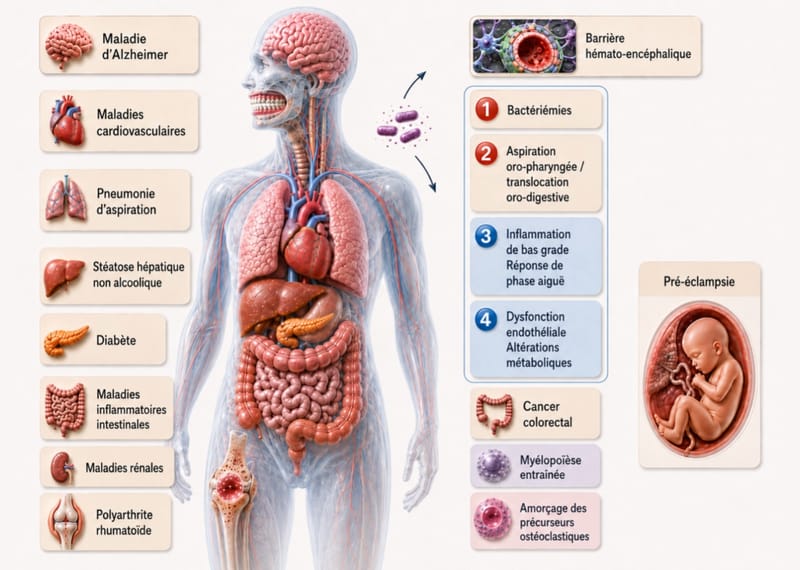
- Bacteraemia: through the ulcerated lining of periodontal pockets, bacteria briefly enter the bloodstream, even during chewing or brushing [6].
- Low-grade inflammation: inflammatory mediators (IL-6, TNF-α) and CRP, a protein made by the liver, rise in the blood; periodontal treatment brings CRP down by 0.69 mg/L on average at six months [7].
- Oral–gut spread: swallowed bacteria and immune cells activated in the mouth can reach the gut, according to animal models [6].
- Endothelial dysfunction: the inner lining of the arteries dilates less well; it recovers six months after intensive periodontal treatment [8].
- Trained myelopoiesis: periodontal inflammation durably 'programmes' bone-marrow stem cells, which then release more reactive white blood cells; described mainly in animals, this mechanism could link several inflammatory diseases [6].
Pregnancy, kidneys, rheumatoid arthritis: three links to know
Pregnancy. Under the influence of hormones, the gums react more to plaque, and gum bleeding is common in pregnant women [10]. Observational studies find an independent association between periodontitis and preterm birth, low birth weight or pre-eclampsia [10]. As for treatment, the Cochrane review finds a possible reduction in low birth weight [11]. In these trials, non-surgical periodontal treatment was carried out during pregnancy; a current or planned pregnancy should therefore be mentioned to the practice.
Chronic kidney disease. In a large population study, severe periodontitis goes hand in hand with lower kidney function and more albumin in the urine [12]. CRP falls after periodontal treatment [13]. Anyone under follow-up for kidney disease has every reason to mention it and their medication, and the periodontal report can be sent to the nephrologist.
Rheumatoid arthritis. A meta-analysis finds more periodontitis in patients with rheumatoid arthritis than in healthy controls [14]. The mechanism studied involves P. gingivalis, which can modify proteins (citrullination) that patients' immune systems then turn against [6]. After non-surgical periodontal treatment, disease activity (DAS28 score) falls in the short term in the available trials, with follow-up of six weeks to six months [15]. When the hands are affected, brushing becomes difficult: aids can be discussed at the consultation.
The best-documented links
The best-documented link concerns diabetes: the 2022 Cochrane review measures a fall in HbA1c after periodontal treatment, with moderate certainty [3]. For the heart and blood vessels, the association is firmly established and some markers improve after treatment [5] [7] [8]. For Alzheimer's disease, meta-analyses find a risk about 20% higher, and P. gingivalis has been found in patients' brains [16] [17] [18]. For digestive cancers, periodontitis is associated with a higher risk of colorectal, oesophageal, gastric and pancreatic cancer [23] [28] [29]. Each article details the studies.
Periodontitis is treated first in its own right: it destroys bone and costs teeth. Two measures have an established benefit for both the gums and general health: stopping smoking and controlling diabetes [27].
Prevention, nutrition, micronutrition: what place for this perspective?
Dr Hazout has extended his training as a periodontist with a university diploma (DU) in anti-ageing and preventive medicine (2025) and a European university diploma in micronutrition and preventive medicine (2026). This perspective helps to read the inflammatory background on which periodontitis takes hold; it accompanies the mechanical treatment of the pockets and never stands in for it. The consultation therefore includes a lifestyle review: smoking, diet (free sugars, ultra-processed foods), physical activity, sleep, current medication and medical history.
- If you have risk factors for diabetes and no recent check-up, Dr Hazout suggests raising it with your GP, as the scientific societies recommend [27]; with your consent, the practice sends them a periodontal report.
- Diet weighs on gum inflammation: the trials, their limits and the advice that follows are detailed in the article on nutrition, micronutrition and inflammation.
- No food supplement is offered as a matter of course, and none treats periodontitis; tests and supplements are sorted out in the article on blood tests and supplements.
What this means for you
If you live with a general disease and have signs of periodontitis (bleeding gums, receding gums, loose teeth), the two sets of care benefit from knowing about each other. At the practice in Levallois-Perret, your medical situation is taken into account from the first visit. Periodontitis treatment is the same as for any patient, adjusted to your state of health, and maintenance preserves the results.
If you are in good health, remember this: periodontitis is common, often silent, and it is treated first because it damages the mouth. A benefit for the heart or the brain is possible.
Related articles
Diabetes and periodontitis: a two-way link, with the figures
Diabetes raises the risk of periodontitis; periodontitis, in turn, makes blood sugar harder to control. No relationship between the mouth and a general disease is better…

Periodontitis, heart and blood vessels: where does the evidence really stand?
People with periodontitis more often have cardiovascular disease: cardiologists and periodontologists recognise this link, found in large studies. This article sets out…
Periodontitis and Alzheimer's disease: a real association, mechanisms under study
Several large studies, including two cohorts published in 2026, link periodontitis to a higher risk of dementia and Alzheimer's disease, and the bacterium…

Nutrition, micronutrition and periodontal inflammation: what the studies show
Diet weighs on gum inflammation: a handful of randomised trials show as much, over short periods and with modest effects. Whether periodontitis feeds the chronic…

Why bacterial sampling and blood testing appear useful
Periodontitis is not only pockets and X-rays: it is part of each patient's overall health. At the Levallois-Perret practice, the first treatment session includes a…
Frequently asked questions
Can my periodontitis cause a heart attack?
Studies find a solid association and plausible mechanisms, and periodontal treatment improves some vascular markers. Your cardiologist and your periodontist benefit from talking to each other.
If I have my gums treated, will my diabetes improve?
On average, yes, modestly: the 2022 Cochrane review measures a fall in HbA1c a few months after treatment. The effect varies from person to person and never replaces diabetes treatment.
Should I tell my doctor that I have periodontitis?
Yes, and it is useful, especially if you have diabetes, cardiovascular disease, kidney disease, rheumatoid arthritis or are pregnant. European recommendations encourage this coordination between dentists and family doctors.
I am pregnant: can my gums be treated?
Yes. In the clinical trials, non-surgical periodontal treatment was carried out during pregnancy. Simply tell the practice about the pregnancy.
Does periodontal treatment protect against Alzheimer's disease?
The question is being studied. Meta-analyses associate periodontitis with a dementia risk about 20% higher, and the bacterium P. gingivalis has been found in patients' brains; treatment reduces inflammation and bacteria in the mouth.
Scientific sources (29)
- Sanz M, Ceriello A, Buysschaert M, Chapple I, Demmer RT, Graziani F, et al. Scientific evidence on the links between periodontal diseases and diabetes: Consensus report and guidelines of the joint workshop on periodontal diseases and diabetes by the International Diabetes Federation and the European Federation of Periodontology. J Clin Periodontol. 2018;45(2):138-149. DOI
- Zhao Y, Zhang C, Chang X, Zhang J, Shu C, Lin C, Hou J. Causal association between periodontitis and systemic diseases: a systematic review and meta-analysis of mendelian randomization studies. BMC Oral Health. 2026;26:383. DOI
- Simpson TC, Clarkson JE, Worthington HV, MacDonald L, Weldon JC, Needleman I, et al. Treatment of periodontitis for glycaemic control in people with diabetes mellitus. Cochrane Database Syst Rev. 2022;4:CD004714. PubMed
- Sanz M, Marco del Castillo A, Jepsen S, Gonzalez-Juanatey JR, D'Aiuto F, Bouchard P, et al. Periodontitis and cardiovascular diseases: Consensus report. J Clin Periodontol. 2020;47(3):268-288. DOI
- Tran AH, Zaidi AH, Bolger AF, Del Brutto OH, Hegde R, Patton LL, Rausch J, Zachariah JP ; au nom des comités de l’American Heart Association. Periodontal disease and atherosclerotic cardiovascular disease: a scientific statement from the American Heart Association. Circulation. 2026;153:e73-e88 (publié en ligne le 16 décembre 2025). DOI
- Hajishengallis G, Chavakis T. Local and systemic mechanisms linking periodontal disease and inflammatory comorbidities. Nat Rev Immunol. 2021;21:426-440. DOI
- Luthra S, et al. Treatment of periodontitis and C-reactive protein: A systematic review and meta-analysis of randomized clinical trials. J Clin Periodontol. 2023;50(1):45-60. DOI
- Tonetti MS, D'Aiuto F, Nibali L, Donald A, Storry C, Parkar M, et al. Treatment of periodontitis and endothelial function. N Engl J Med. 2007;356(9):911-920. DOI
- Ye Z, Cao Y, Miao C, Liu W, Dong L, Lv Z, Iheozor-Ejiofor Z, Li C. Periodontal therapy for primary or secondary prevention of cardiovascular disease in people with periodontitis. Cochrane Database Syst Rev. 2022;CD009197.pub5. DOI
- Wen X, Fu X, Zhao C, Yang L, Huang R. The bidirectional relationship between periodontal disease and pregnancy via the interaction of oral microorganisms, hormone and immune response. Front Microbiol. 2023;14:1070917. DOI
- Iheozor-Ejiofor Z, Middleton P, Esposito M, Glenny AM. Treating periodontal disease for preventing adverse birth outcomes in pregnant women. Cochrane Database Syst Rev. 2017;6:CD005297. DOI
- Schmidt-Lauber C, Ebinghaus M, Borof K, Lieske B, Klopp A, Thompson C, et al. Association of periodontitis with reduced kidney function and albuminuria in early chronic kidney disease: a population-based study. Int J Oral Sci. 2026;18:33. DOI
- Delbove T, Gueyffier F, Juillard L, Kalbacher E, Maucort-Boulch D, Nony P, et al. Effect of periodontal treatment on the glomerular filtration rate, reduction of inflammatory markers and mortality in patients with chronic kidney disease: A systematic review. PLoS One. 2021;16(1):e0245619. DOI
- Fuggle NR, Smith TO, Kaul A, Sofat N. Hand to mouth: a systematic review and meta-analysis of the association between rheumatoid arthritis and periodontitis. Front Immunol. 2016;7:80. DOI
- Oliveira SR, de Arruda JAA, Schneider AH, et al. Does non-surgical periodontal treatment contribute to rheumatoid arthritis amelioration? Evidence based on an overview and meta-analysis. Odontology. 2025;113:903-917. DOI
- Asher S, Stephen R, Mäntylä P, Suominen AL, Solomon A. Periodontal health, cognitive decline, and dementia: A systematic review and meta-analysis of longitudinal studies. J Am Geriatr Soc. 2022;70(9):2695-2709. DOI
- Dibello V, Custodero C, Cavalcanti R, et al. Impact of periodontal disease on cognitive disorders, dementia, and depression: a systematic review and meta-analysis. GeroScience. 2024;46:5133-5169. DOI
- Dominy SS, Lynch C, Ermini F, Benedyk M, Marczyk A, Konradi A, et al. Porphyromonas gingivalis in Alzheimer's disease brains: Evidence for disease causation and treatment with small-molecule inhibitors. Sci Adv. 2019;5(1):eaau3333. DOI
- Alzforum. Therapeutics – Atuzaginstat (COR388): the GAIN trial, results and programme status (accessed 3 October 2026). alzforum.org
- Li H, Shi M, Yuan R, Wang H, Li Y, et al. Association between periodontitis and non-alcoholic fatty liver disease in community-dwelling adults: a systematic review and meta-analysis. Sci Rep. 2026;16:16217. DOI
- Wu Z, Xiao C, Chen F, Wang Y, Guo Z. Pulmonary disease and periodontal health: a meta-analysis. Sleep Breath. 2022;26:1857-1868. DOI
- Cao Y, Liu C, Lin J, Ng L, Needleman I, Walsh T, Li C. Oral care measures for preventing nursing home-acquired pneumonia. Cochrane Database Syst Rev. 2022;CD012416.pub3. DOI
- Chauca-Bajaña L, Ordoñez Balladares A, Lorenzo-Pouso AI, et al. Periodontitis and oral pathogens in colorectal cancer: a systematic review, meta-analysis, and trial sequential analysis. Dent J (Basel). 2025;13(12):595. DOI
- Ayati A, Khodabandelu S, Khaleghi S, et al. A systematic review and network meta-analysis of the association between periodontitis and inflammatory bowel diseases. BMC Oral Health. 2025;25:463. DOI
- Rosário-dos-Santos HL, Miranda SS, Gomes-Filho IS, et al. Periodontitis severity relationship with metabolic syndrome: A systematic review with meta-analysis. Oral Dis. 2023;29(7):2512-2520. DOI
- Kim CM, Lee S, Hwang W, Son E, Kim TW, Kim K, Kim YH. Obesity and periodontitis: A systematic review and updated meta-analysis. Front Endocrinol. 2022;13:999455. DOI
- Herrera D, Sanz M, Shapira L, Brotons C, Chapple I, Frese T, et al. Association between periodontal diseases and cardiovascular diseases, diabetes and respiratory diseases: Consensus report of the Joint Workshop by the European Federation of Periodontology (EFP) and the European arm of the World Organization of Family Doctors (WONCA Europe). J Clin Periodontol. 2023;50(6):819-841. DOI
- Lo CH, Kwon S, Wang L, Polychronidis G, Knudsen MD, Zhong R, et al. Periodontal disease, tooth loss, and risk of oesophageal and gastric adenocarcinoma: a prospective study. Gut. 2021;70(3):620. DOI
- Maisonneuve P, Amar S, Lowenfels AB. Periodontal disease, edentulism, and pancreatic cancer: a meta-analysis. Ann Oncol. 2017;28(5):985-995. DOI
Page written by Dr Victor Hazout, periodontist · updated on 24 October 2026