






Nutrition, micronutrition and periodontal inflammation: what the studies show
Diet weighs on gum inflammation: a handful of randomised trials show as much, over short periods and with modest effects. Whether periodontitis feeds the chronic inflammation of ageing, or 'inflammaging', is an active line of research, one Dr Hazout explored in his dissertation. This article separates the established from the promising, and draws realistic advice from it, without supplements or protocols.
Key points
- 'Inflammaging' is chronic, low-level inflammation without infection that builds with age [1]; the part periodontitis plays in it is under study.
- Cutting free sugars eases gum inflammation (meta-analysis of 9 studies) [2].
- A 4-week anti-inflammatory diet reduced gum bleeding without altering plaque [3].
- The EFP is candid: it is not yet known whether dietary advice improves the outcome of periodontitis treatment [4].
- Micronutrition sheds light on the inflammatory background and accompanies mechanical treatment; it does not replace it, and no supplement treats periodontitis.
Contents6 sections
- Low-grade inflammation: what is 'inflammaging'?
- Dr Hazout's dissertation: periodontitis as marker and possible modulator
- What do dietary trials on the gums show?
- What does the EFP recommend on dietary advice?
- Micronutrition: what it is, and where it belongs
- Practical advice that squares with the evidence
Low-grade inflammation: what is 'inflammaging'?
Acute inflammation does a job: it repairs a wound or fights an infection, then subsides. Low-grade inflammation is another matter: discreet, persistent, readable in slight rises of blood markers such as high-sensitivity CRP or IL-6. The term inflammaging (a blend of inflammation and ageing) describes this chronic, sterile, smouldering inflammation that settles in with age and is linked to many age-related diseases [1].
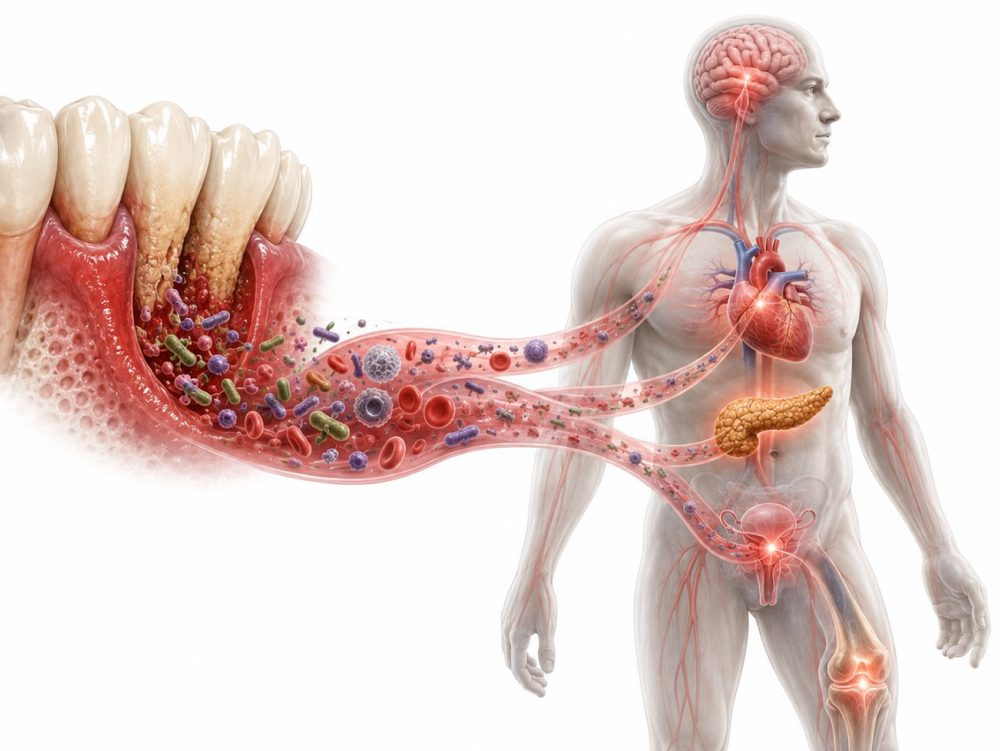
Why does periodontitis interest this field? Because it is common after 50, chronic, and a source of inflammation that can be treated: after treatment, CRP falls on average [5]. Whether that modest fall weighs on long-term health is the question current research is asking.
Dr Hazout's dissertation: periodontitis as marker and possible modulator
In his dissertation for the university diploma (DU) in anti-ageing and preventive medicine (2025), Dr Hazout tested the hypothesis that periodontitis may be both a marker (a visible sign) and a possible modulator (a contributor) of age-related chronic inflammation. The table below sorts the elements of this work by level of evidence: what trials support, and what remains to be shown.
| Item | Level of evidence |
|---|---|
| Periodontal treatment lowers HbA1c in people with diabetes | Probable: average reduction of about 0.4 points at 3–4 months (randomised trials, moderate certainty) [6] |
| Periodontal treatment lowers CRP | Demonstrated on average (−0.69 mg/L at 6 months) [5] |
| Treatment improves endothelial function | Shown in a randomised trial at 6 months [7]; non-significant result in a more recent meta-analysis [8] |
| Treatment lowers blood lipids | Not confirmed by recent meta-analyses [8] |
| IL-6, microbiota, salivary calprotectin as monitoring markers | Research avenues; no validated clinical use in periodontology |
| Microbiota modulation, coenzyme Q10, curcumin, resveratrol, metformin, senolytics | Hypotheses; none is validated for slowing ageing or reducing general inflammation. European guidelines rule out metformin gel as an adjunct to treatment [4] |
The avenues in the last row are cited because they appear in the research literature, not because they belong in the consultation: none is offered at the practice, and the treatment of periodontitis remains root surface debridement, maintenance and control of risk factors.
What do dietary trials on the gums show?
Gingivitis, a reversible inflammation of the gums, makes a good model for testing diet: it responds within a few weeks.
- Anti-inflammatory diet: in a randomised trial at the University of Freiburg, Germany (30 people with gingivitis, 4 weeks), a diet low in processed carbohydrates and animal protein and rich in omega-3s, vitamins C and D, antioxidants, plant nitrates and fibre markedly reduced gum bleeding, with no difference in plaque between the groups [3]. The effect, then, does not come from a change in hygiene.
- Free sugars: a meta-analysis of 9 controlled studies shows that restricting free sugars (added sugars, honey, syrups, juices) improves gum inflammation scores [2].
- Mediterranean diet and intermittent fasting: the EFP cites trials showing less gum bleeding [9].
Their limits: these trials are small and short, and mostly concern gingivitis. They do not show that a diet cures established periodontitis or wards off general diseases.
What does the EFP recommend on dietary advice?
The 2020 European guidelines remain cautious. For the treatment of periodontitis: 'we do not know whether dietary counselling may have a positive impact' (R1.9). For the maintenance phase, it is equally unknown whether physical activity, dietary counselling or weight loss matter (R4.20) [4]. Stopping smoking (R1.6) and controlling diabetes (R1.7), on the other hand, are recommended [4]: the two lifestyle measures whose benefit for the gums is established.
Yet in its publications for clinicians, the EFP stresses that diet and obesity weigh on periodontal inflammation, and encourages clinicians to treat diet as an everyday risk factor [9]. Obesity is indeed associated with periodontitis [10]. The link with diabetes is detailed in the article on diabetes and periodontitis.
Micronutrition: what it is, and where it belongs
Micronutrition concerns micronutrients: vitamins, minerals, trace elements, essential fatty acids and polyphenols. Its purpose is to spot insufficient or unbalanced intakes and correct them first through food and, only when necessary, through supplements prescribed by a doctor. It is not a medical specialty in its own right, and not all of its 'assessment' tools are validated.
What is established: severe vitamin C deficiency causes scurvy, with bleeding gums; vitamin C supplementation reduces bleeding in gingivitis, but does nothing for pockets in periodontitis [11]. What is debated: omega-3s, vitamin D, coenzyme Q10 or probiotics as adjuncts to treatment; they are reviewed one by one in the article on blood tests and supplements. None is a treatment for periodontitis.
Practical advice that squares with the evidence
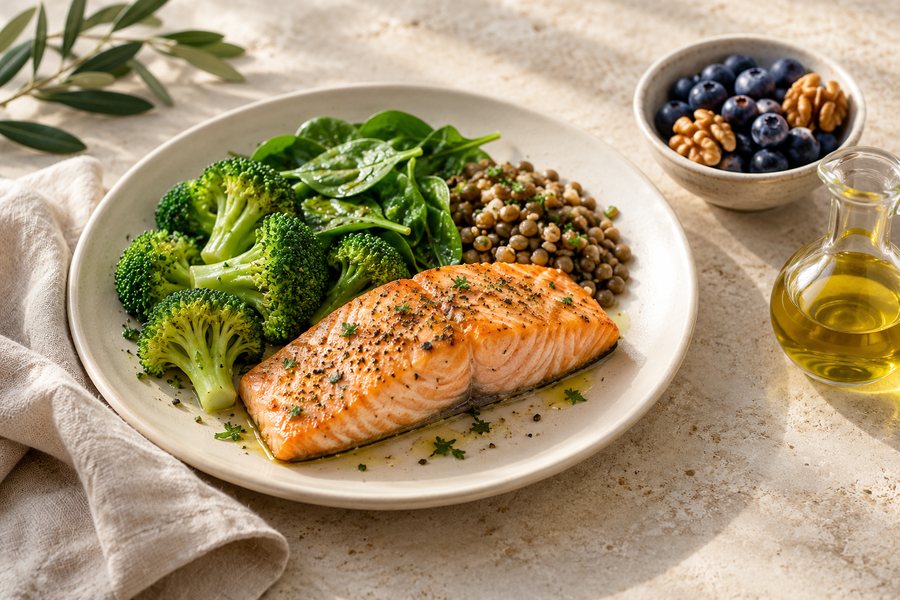
- Limit free sugars: sugary drinks, juices, sweets, biscuits.
- Favour minimally processed foods: vegetables, fruit, pulses, whole grains, nuts.
- Eat seafood, oily fish above all, about twice a week for enough omega-3s, as the EFP suggests [9].
- Stop smoking: the most firmly established lifestyle measure in periodontology [4].
- Never rely on diet in place of brushing, interdental brushes and periodontal treatment.
This advice accompanies the mechanical treatment of the pockets; it does not stand in for it. Treatment is described on the periodontitis treatment page, follow-up on the maintenance page, and the place of this topic among the links between periodontitis and general diseases on the general health page.
Frequently asked questions
Can a diet cure my periodontitis?
No. Diet can ease gum inflammation, but established periodontitis calls for professional treatment and suitable hygiene.
What is inflammaging?
Chronic, low-level inflammation that builds with age. The role of periodontitis in this process is under study.
Should I take food supplements for my gums?
Not routinely. Most supplements have not shown a clear benefit alongside treatment. A confirmed deficiency is treated with your GP, who prescribes if necessary.
Should my CRP or IL-6 be measured to monitor my gums?
No. The state of the gums is monitored by periodontal examination (bleeding, pockets). These blood markers are not specific and do not guide periodontal treatment.
Why is a periodontist interested in nutrition?
Because gum inflammation responds to diet, smoking and diabetes. Dr Hazout has extended his training with university diplomas in preventive medicine and micronutrition so as to address these factors rigorously, alongside treatment and never in its place.
Scientific sources (11)
- Franceschi C, Garagnani P, Parini P, Giuliani C, Santoro A. Inflammaging: a new immune-metabolic viewpoint for age-related diseases. Nat Rev Endocrinol. 2018;14(10):576-590. DOI
- Woelber JP, Gebhardt D, Hujoel PP. Free sugars and gingival inflammation: A systematic review and meta-analysis. J Clin Periodontol. 2023;50:1188-1201. DOI
- Woelber JP, et al. The influence of an anti-inflammatory diet on gingivitis. A randomized controlled trial. J Clin Periodontol. 2019;46(4):481-490. DOI
- Sanz M, Herrera D, Kebschull M, Chapple I, Jepsen S, Berglundh T, et al. Treatment of stage I–III periodontitis—The EFP S3 level clinical practice guideline. J Clin Periodontol. 2020;47(Suppl 22):4-60. DOI
- Luthra S, et al. Treatment of periodontitis and C-reactive protein: A systematic review and meta-analysis of randomized clinical trials. J Clin Periodontol. 2023;50(1):45-60. DOI
- Simpson TC, Clarkson JE, Worthington HV, MacDonald L, Weldon JC, Needleman I, et al. Treatment of periodontitis for glycaemic control in people with diabetes mellitus. Cochrane Database Syst Rev. 2022;4:CD004714. PubMed
- Tonetti MS, D'Aiuto F, Nibali L, Donald A, Storry C, Parkar M, et al. Treatment of periodontitis and endothelial function. N Engl J Med. 2007;356(9):911-920. DOI
- Meng R, Xu J, Fan C, Liao H, Wu Z, Zeng Q. Effect of non-surgical periodontal therapy on risk markers of cardiovascular disease: a systematic review and meta-analysis. BMC Oral Health. 2024;24:692. DOI
- European Federation of Periodontology. How do diet and obesity affect periodontitis and the response to treatment? EFP Publications hub (accessed 3 October 2026). efp.org
- Kim CM, Lee S, Hwang W, Son E, Kim TW, Kim K, Kim YH. Obesity and periodontitis: A systematic review and updated meta-analysis. Front Endocrinol. 2022;13:999455. DOI
- Fageeh HN, Fageeh HI, Prabhu A, Bhandi S, Khan S, Patil S. Efficacy of vitamin C supplementation as an adjunct in the non-surgical management of periodontitis: a systematic review. Syst Rev. 2021;10:5. DOI
Related treatments
Periodontitis and general health: what the studies really show
Periodontitis is a chronic inflammation of the tissues that support the teeth. Studies link it to many general diseases: diabetes, heart and blood-vessel disease,…
Periodontal maintenance: keeping results over time
Once the pockets have been treated, treatment is not over: it changes pace. Maintenance, or supportive periodontal care, serves to detect any return of the disease early…
Read next

Why bacterial sampling and blood testing appear useful
Periodontitis is not only pockets and X-rays: it is part of each patient's overall health. At the Levallois-Perret practice, the first treatment session includes a…
Pregnancy and gums: what changes, what matters
During pregnancy, many women find that their gums swell and bleed when they brush. This is neither inevitable nor, in itself, a danger to the baby: most often it is…
Understanding periodontitis: recognising the signs and how it is diagnosed
Periodontitis is among the most common chronic diseases, and among the least noticed. It advances without pain, and its first signs pass for merely irritated gums:…